
In this article
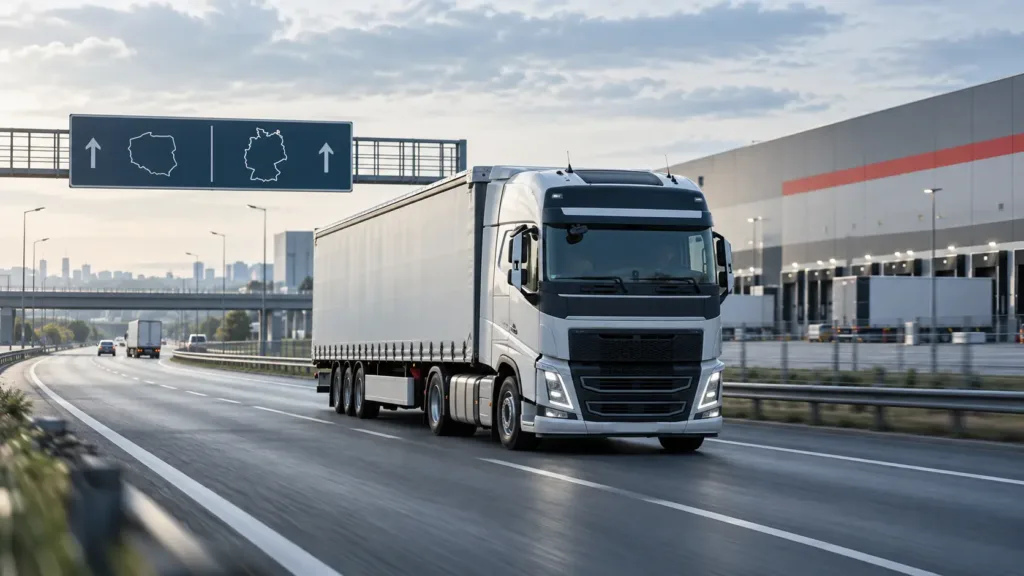
Freight delivery from Poland to Germany is a typical European road-logistics lane. The two countries share a land border, making direct road transport between the shipper and consignee a practical solution for many commercial shipments.
However, one route does not mean one transport model. A single pallet, a full truckload, an urgent spare part and a dangerous-goods shipment require different equipment and planning. Routine commercial cargo may use standard cargo delivery, while a strict deadline may justify a dedicated express movement.
Transport planning therefore needs more than approximate mileage. Shipment dimensions, weight, number of packages, loading method, warehouse opening hours, commodity requirements and the requested delivery window all affect the final solution.
Main transport options between Poland and Germany
Road freight is the most direct option for many shipments. Goods can be collected at a warehouse in Poland and delivered to the consignee in Germany without the need for a terminal-based transport chain.
Common solutions include:
| Option | Best suited to | Key characteristic |
|---|---|---|
| FTL | Larger consignments or shipments requiring a dedicated truck | Direct transport with minimal intermediate handling |
| LTL | Several pallets or partial loads | Vehicle capacity is shared with other shipments |
| Express van | Smaller time-critical cargo | Dedicated routing around one shipment |
| Specialised transport | ADR, temperature-controlled or other special cargo | Requirements need to be verified in advance |
FTL can make sense when the cargo occupies a large proportion of the vehicle or when additional handling should be minimised. LTL is useful for smaller commercial consignments that do not justify booking an entire truck.
For time-sensitive shipments, express transport up to 3.5 t may be considered. A dedicated vehicle can then be planned around the cargo-ready time and required arrival window.
What determines transit time
There is no single transit time that applies to every shipment from Poland to Germany. Even movements between the same two countries can require very different operating plans.
Actual timing depends on:
- the exact collection location;
- the final delivery address in Germany;
- cargo-ready date and time;
- FTL, LTL or express format;
- availability of suitable equipment;
- road conditions and detours;
- driver operating rules;
- loading and unloading time windows;
- special commodity requirements.
A shipment from western Poland to eastern Germany is operationally different from a movement from south-eastern Poland to western Germany. The distance and distribution of loading and delivery points matter more than the country names alone.
LTL may also involve consolidation, additional collection or delivery points and terminal operations. Dedicated transport generally has a shorter operational chain.
Information required for a freight quotation
The quality of the quote depends on the quality of the shipment data. A request saying only “one pallet from Poland to Germany” leaves too many variables unresolved.
Useful information includes:
- full collection address;
- full delivery address;
- cargo-ready date and time;
- requested delivery deadline;
- number of packages;
- dimensions of every package;
- total and, where useful, individual weight;
- packaging type;
- commodity description;
- whether packages are stackable;
- loading method, such as dock, rear or side loading;
- site-access restrictions;
- ADR, temperature or other special requirements.
Dimensions can matter as much as weight. A lightweight but bulky shipment may occupy a large part of a vehicle, while a compact heavy load may require a payload check.
For urgent cargo, the absolute latest acceptable delivery time should be stated clearly. “As soon as possible” is not precise enough to compare realistic routing options.
Documents for Poland–Germany freight
Routine commercial movements between Poland and Germany operate differently from imports entering the EU from a third country. Nevertheless, commercial road transport still requires consistent supporting documentation.
Depending on the transaction and commodity, documents may include the transport document, commercial invoice, packing list, delivery confirmation and other records required by the parties or by the specific product category.
Special attention is required for regulated goods. Dangerous goods need an ADR assessment before dispatch, and other product categories may be subject to additional documentation or restrictions even when they move within the EU.
The documents should reflect the physical shipment. Package count, weight, consignor, consignee and commodity description should not conflict with the information given to the carrier.
Special cargo categories
A standard curtain-side truck is not suitable for every shipment. Special characteristics should be disclosed before pricing and vehicle selection.
Dangerous goods. Goods subject to ADR require classification, packaging, marking and transport-condition checks. Speedixa has a dedicated page for hazardous goods delivery.
Temperature-controlled cargo. Goods requiring a defined temperature range need suitable equipment and agreed operating conditions.
Oversized or heavy pieces. Accurate dimensions, weight, centre of gravity and loading method become especially important. Special equipment or route planning may be needed.
Fragile or valuable cargo. Packaging, securing, handling and final handover arrangements should be determined before dispatch.
The safest approach is to disclose unusual cargo characteristics from the start. Discovering them after the truck has already been assigned may require a different vehicle or transport plan.
What affects transport cost
Freight cost between Poland and Germany is shipment-specific. A universal price per country pair or pallet does not reflect the actual operational conditions.
Main factors include:
- distance between exact addresses;
- vehicle type;
- FTL, LTL or dedicated express service;
- weight and volume;
- package count;
- urgency;
- special equipment;
- loading and unloading requirements;
- ADR or temperature control;
- additional operating constraints.
For LTL, the space occupied and the groupage network are particularly important. In FTL, the dedicated vehicle, route and overall shipment profile are central. For express movements, urgent positioning of the required vehicle can also influence the quotation.
When comparing offers, it is useful to provide every forwarder with exactly the same shipment data. Otherwise different prices may actually correspond to different transport assumptions.
Practical checklist before dispatch
A short pre-booking check can prevent many operational problems.
- Confirm addresses. Provide exact collection and delivery points with postal codes.
- Confirm readiness. The cargo should be physically packed and available at the stated time.
- Check dimensions and weight. Measure every package and verify the weight.
- Describe the commodity. Do not use “general cargo” if the goods have special characteristics.
- Confirm loading arrangements. Check dock availability, loading equipment and vehicle-access limitations.
- Agree the delivery window. The consignee should be ready to receive the shipment.
- Prepare documents. Documentation should match the actual cargo.
This approach helps select the right equipment at the first attempt and reduces the risk of a failed collection caused by incorrect dimensions, unsuitable equipment or missing information.
What this means for your business
Freight from Poland to Germany can move as FTL, LTL, dedicated express transport or a specialised shipment. The right option depends on the cargo and operating requirements rather than on the country pair alone.
Accurate planning starts with exact addresses, cargo-ready time, package count, dimensions, weight, commodity description and loading conditions. ADR, temperature-controlled or other regulated cargo should be declared before vehicle selection.
The most robust transport plan is the one that reflects not only distance but also warehouse operations, cargo requirements and the consignee’s actual delivery window.
Questions & answers
Which transport mode is commonly used from Poland to Germany?
Road freight is the main option for many commercial shipments. Depending on shipment size and urgency, this can be FTL, LTL or a dedicated express vehicle.
What information is needed for a freight quote?
Provide exact addresses, cargo-ready time, package count, dimensions, weight, commodity description, loading and unloading conditions and any ADR, temperature or other special requirements.
Is customs clearance required between Poland and Germany?
Routine movements within the EU are handled differently from imports entering from third countries. Commercial and transport documentation still needs to be correct, and specific goods may remain subject to additional requirements.
Should I choose FTL or LTL?
FTL usually suits larger consignments or shipments requiring a dedicated truck. LTL is more appropriate for smaller loads that do not require the full vehicle capacity. The choice also depends on deadlines and handling requirements.